


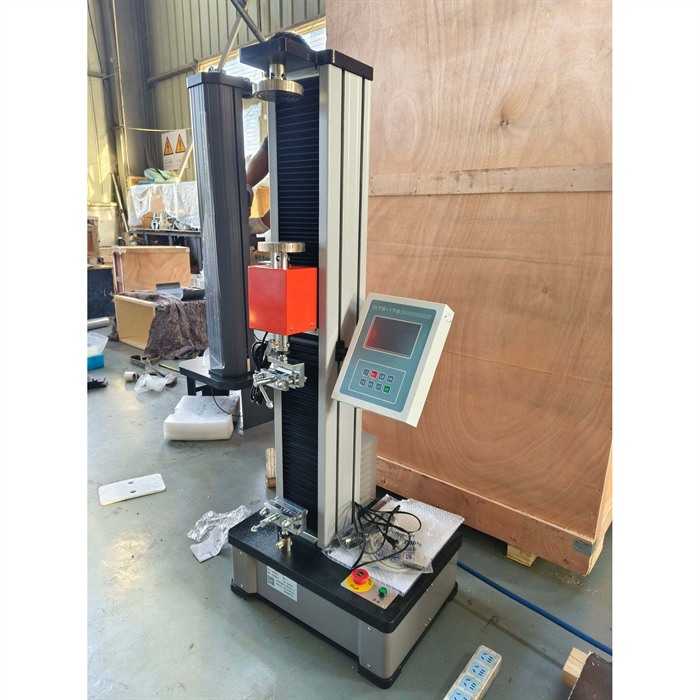
KASON ETM203Tis asingle column touch screen universal testing machinebuilt for laboratories that switch between materials rather than between machines. It runs tensile, compression, flexure, shear, tear and peel Tests, and it arrives with the grips, Compression Platens and touch screen software needed to start Testing.
Key Takeaways
- One frame covers tension, compression, flexure, shear, tear and peel, so a laboratory does not need a separate bench for each test type.
- The single column design places tensile testing below the moving beam and compression testing above it, keeping the machine compact while still offering two test spaces.
- A touch screen controller runs the test, keeps the batch results and prints the report, so an operator can complete a run without a separate computer beside the machine.
- Force, displacement and deformation are held in closed loop, which is what makes a result comparable between operators and between sessions.
What the ETM203T Is Built For
The machine is aimed at flexible and semi-rigid materials rather than structural steel. Typical work includes plastics and reinforced composites, films and foils, rubber, adhesives, textiles and webbing, paper and packaging, foams and timber, plus finished components from medical and electronics production. Because the accessory range extends to grips, fixtures, compression frames, thermal cabinets and extensometers, the same frame can be re-tasked as a laboratory test list changes.
Single Column, Double Space: What the Frame Layout Changes
Instead of two test zones stacked inside a wide four column frame, this machine uses one column with the moving beam suspended between an upper and a lower space. Tensile specimens are loaded in the lower space and compression specimens in the upper space, so the footprint stays small enough for a bench or a corner of the laboratory. The frame itself is not a lightweight compromise: the moving beam and table are machined from steel plate, three columns of mandatory orientation hold the main unit rigid, and the ball screw drive removes transmission clearance so that force and deformation speed stay under precise control. A shield plate with a limit mechanism caps how far the beam can travel, protecting the sensor if an operator misjudges specimen length. Grips are bolted on rather than threaded, so changing from a tensile grip to a compression Platen is a matter of minutes.
A Touch Screen That Carries the Test Through
The controller is the operator whole interface. A main menu offers dedicated entries for tensile test, compression test, tearing property, stripping quality, transverse test, force retention, waterproof coil, casing pressure, tensile strength and paper softness, so common methods are one tap away instead of a configuration exercise. Inside a test, the screen shows force, deformation and position together with the force-time, force-deformation and deformation-time curves, and it maintains a result table for the batch. A parameter page lets the operator set loading mode, preload speed, return speed, starting force, break detection and specimen cross section, and a micro printer outputs maximum load, deformation, speed, test date and the load-time curve as a permanent record for the file. Status lines along the bottom report sensor state, beam status, limit state and any force overload while the test is running.
Standards and Materials Covered
The datasheet lists the following method coverage. Match it against your specimen geometry and required fixtures before ordering:
- Plastics and reinforced composites: ASTM D638 and ISO 527 for tensile properties, ISO 604 and ASTM D695 for compressive properties, ISO 14125 for flexural properties, ASTM D3846 for in-plane shear strength
- Thermoplastic pipes: EN ISO 6259, EN ISO 9969, EN ISO 13968 and EN ISO 844
- Geotextiles and webbing: BS EN ISO 10319 wide-width tensile test, ASTM D3950, ASTM D6775-02
- Force verification and strain measurement: ASTM E4, ISO 7500-1, EN 10002-2, BS 1610, DIN 51221, ASTM E83, ISO 9513, BS 3846 and EN 10002-4
Frequently Asked Questions
1. Can one machine really run both tensile and compression tests?
Yes. The frame has a lower space for tension and an upper space for compression, so both test types run on the same column without dismantling the machine. Flexure, shear, tear and peel tests are added by fitting the appropriate fixture.
2. Which materials is it not suitable for?
Structural metals and heavy construction materials. The ETM203T is designed around flexible and semi-rigid specimens such as plastics, films, rubber, textiles and packaging. Metallurgical and concrete work is served by theservo-hydraulic universal testing machinesinstead.
3. How does the touch screen simplify daily testing?
Common methods are pre-listed on the main menu, the live curves and batch result table stay on screen during the run, and the built-in printer produces the record at the end. Data handling stops being a separate step.
4. What accessories should be ordered with the machine?
At minimum thegripsthat match your specimen form, plus a compression platen if you test in compression. Anextensometeror a High And Low Temperature Chamber can be added later if the test scope expands.
5. How is accuracy maintained over time?
The Load Cell is calibrated according to the force verification standards listed above, and aload cell calibration toolsupports the routine verification your quality system requires.
Contact me if you are interested!
Email: admin@jnkason.com
Whatsapp: +86 15910081986